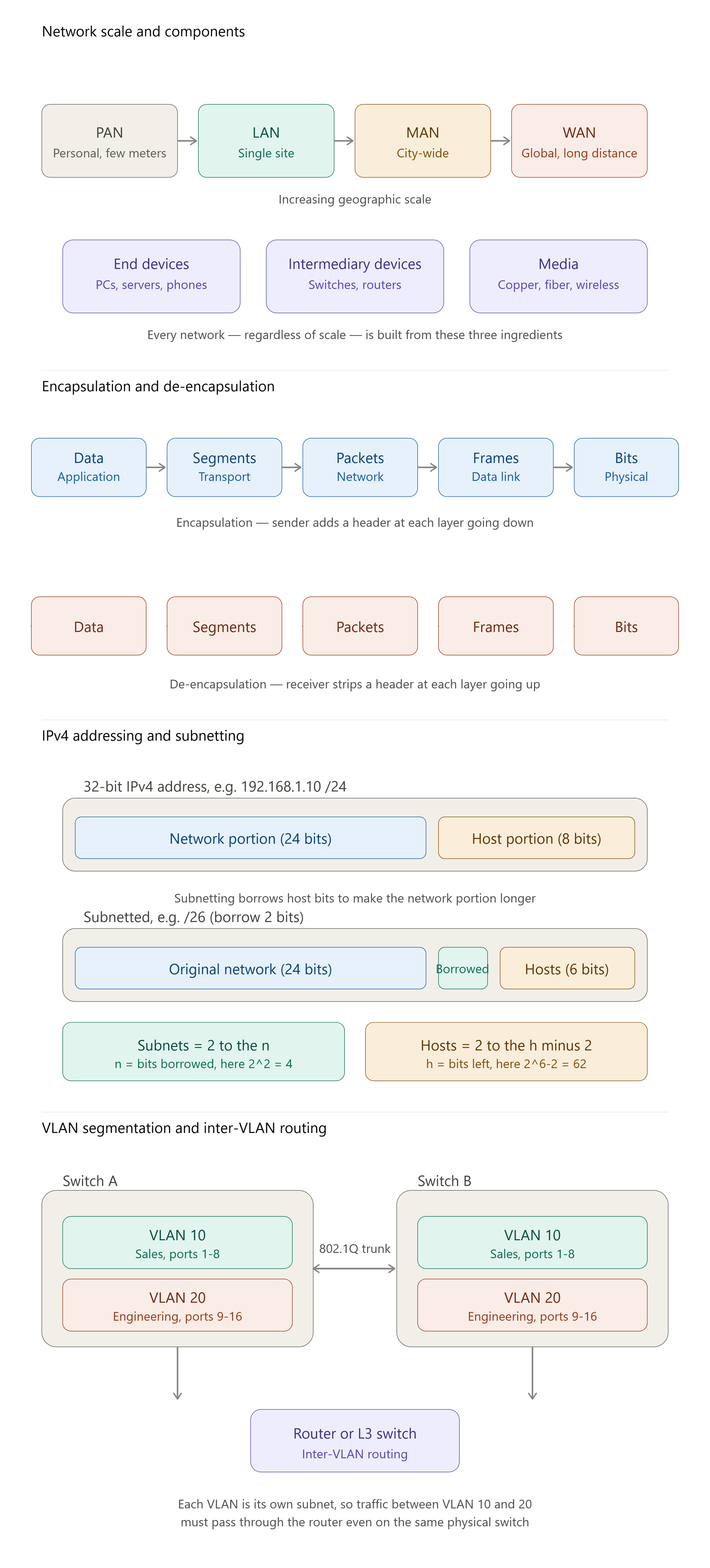
Module 1 – Network Fundamentals: Networks connect end devices (PCs, servers) via intermediary devices (switches, routers) and media (copper, fiber, wireless). Networks are classified as LAN, WAN, MAN, or PAN, and described using physical (cabling) or logical (addressing/flow) topology diagrams. Key performance metrics: bandwidth (theoretical max), throughput (actual rate), goodput (usable data rate). Reliable networks offer fault tolerance, scalability, QoS, and security.
Module 2 – Protocols and Models: Protocols are rule sets governing communication, often combined into suites (TCP/IP). The OSI model (7 layers: Physical, Data Link, Network, Transport, Session, Presentation, Application) is a teaching reference; the TCP/IP model (Network Access, Internet, Transport, Application) is used practically. Data moves down the stack via encapsulation (Data→Segments→Packets→Frames→Bits) and up via de-encapsulation. Addressing types: MAC (Layer 2), IP (Layer 3), Port (Layer 4).
Module 3 – IPv4 Addressing Part 1: IPv4 addresses are 32-bit, written in dotted decimal. A subnet mask (e.g., /24) splits the address into network and host portions. Special addresses include network, broadcast, loopback (127.0.0.1), and private ranges (10.x, 172.16–31.x, 192.168.x). Addressing can be static or dynamic (DHCP).
Module 4 – IPv4 Addressing Part 2: Subnetting divides networks by borrowing host bits (subnets = 2ⁿ; hosts = 2ʰ−2), reducing broadcasts and improving organization. VLSM allows variable-sized subnets to minimize address waste.
Module 5 – VLANs: VLANs logically segment switch ports into separate broadcast domains, improving security and manageability regardless of physical location. Trunk links with 802.1Q tagging carry multiple VLANs between switches. Since VLANs are separate subnets, inter-VLAN routing (via router or Layer 3 switch) is required for communication between them.
- Teacher: Admin User